
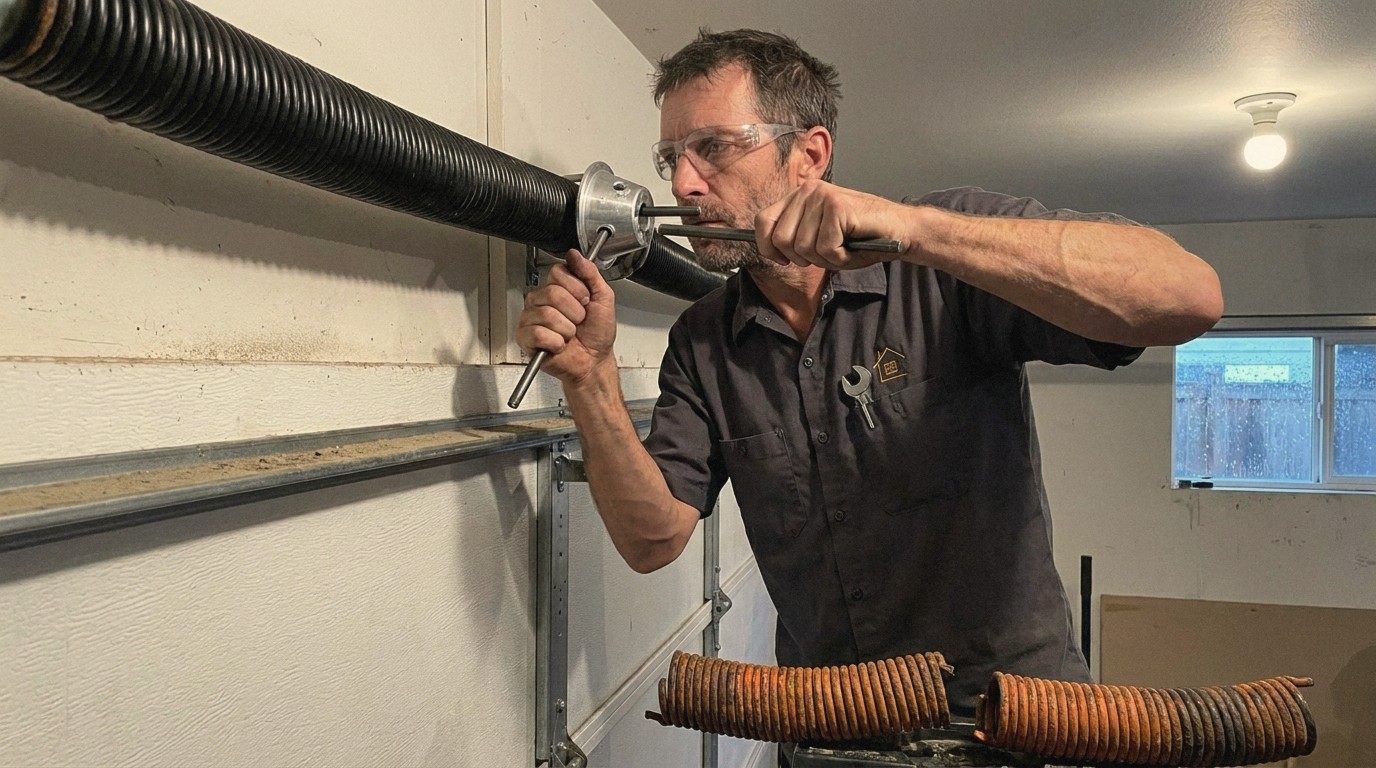
How long do garage door springs last in Western Washington? A standard torsion spring is rated for about 10,000 cycles, where one cycle is the door going up and back down once. For a Renton, Kent or Tukwila household that opens the door four times a day, that works out to roughly seven years. In practice, plan on roughly four to seven years depending on daily use and moisture, because in an unheated attached garage rust on the wire often ends a spring’s life before the cycle count runs out. High-cycle springs rated for 25,000 cycles or more can double or triple that lifespan on the same door.
Cycle ratings: what 10,000 cycles actually means
Garage door springs are rated by cycles, not years, and the long-standing industry baseline is a 10,000 cycle spring. High-cycle springs use a longer coil or a different wire and diameter combination that lowers the stress on each coil per cycle, and they are sold in 25,000, 50,000 and higher ratings. The rating assumes a correctly sized spring, wound to the right number of turns, on a door that is balanced. The Door and Access Systems Manufacturers Association’s Technical Data Sheet 190, Factors Affecting Spring Cycle Life, notes that handling, installation and door usage all change the outcome, and that rust reduces the effective area of the spring wire and causes corrosion pits.
How daily use turns cycles into years
Count how many times the door moves on a normal day, then use this table. Two working adults who both park inside, plus kids and deliveries, easily reach six to eight cycles a day in a Fairwood or Kent East Hill household; a single driver with a second car on the driveway may be closer to two.
| Door cycles per day | 10,000 cycle spring | 25,000 cycle spring | 50,000 cycle spring |
|---|---|---|---|
| 2 per day | about 14 years | about 34 years | about 68 years |
| 4 per day | about 7 years | about 17 years | about 34 years |
| 6 per day | about 4.5 years | about 11 years | about 23 years |
| 8 per day | about 3.5 years | about 8.5 years | about 17 years |
Those numbers are a ceiling, not a promise. They assume a dry garage and a balanced door; in a damp attached garage in Renton or Kent, plan on roughly two thirds of the standard spring figures, so a four cycle per day door is closer to four or five years.
Moisture and rust: why springs in Renton, Kent and Tukwila fail early
Rust is the main reason garage door springs in Renton, Kent and Tukwila fail short of their cycle rating. Renton’s wet season runs from early October to the start of May, November is typically the wettest month with six inches or more of rain, and many attached garages here are unheated and uninsulated. Warm, damp air from the house side meets cold steel above the door, condensation forms on the coils on cold nights, and the factory oil film wears off. Homes on the valley floor in Tukwila and the Kent Valley, near the Green River and the Cedar River, and anywhere with a north-facing garage under tree cover see the most of it.
Rust does two things to a garage door spring in a Renton or Kent garage. It thins the wire, so the same door load produces more stress in the coil, and it pits the surface, and each pit is a stress riser where a fatigue crack can start. A spring that would have made 10,000 cycles dry can let go at 6,000 or 7,000 wet. The practical counters are a light coat of silicone or lithium garage door lubricant on the springs twice a year, galvanized or coated springs on replacement, and a ventilated garage. Never use a penetrating spray as a spring lubricant; it strips what protection is left.
Torsion vs extension springs: which does your Renton or Kent home have?
Torsion springs are the single or paired coils mounted on a steel shaft above the door opening. They lift the door by winding and unwinding around that shaft, and they are standard on doors installed from the 1990s onward. Extension springs are the long, thinner springs that stretch along each horizontal track above the door, one per side, and they are common on 1960s to 1980s ranch homes in Tukwila, the older parts of Kent and south Renton. Extension springs are rated the same way, around 10,000 cycles, but they fail differently: a torsion spring that breaks stays on its shaft, while an extension spring that breaks without a safety cable can whip across the garage. If your door has extension springs and no cable running through the center of each spring, add safety cables on the next service visit.
Warning signs a garage door spring is about to fail, or already has
- A loud bang from the garage. A torsion spring stores enough energy that the break sounds like a firework or something falling off a shelf. If you heard it and nothing fell, look at the springs.
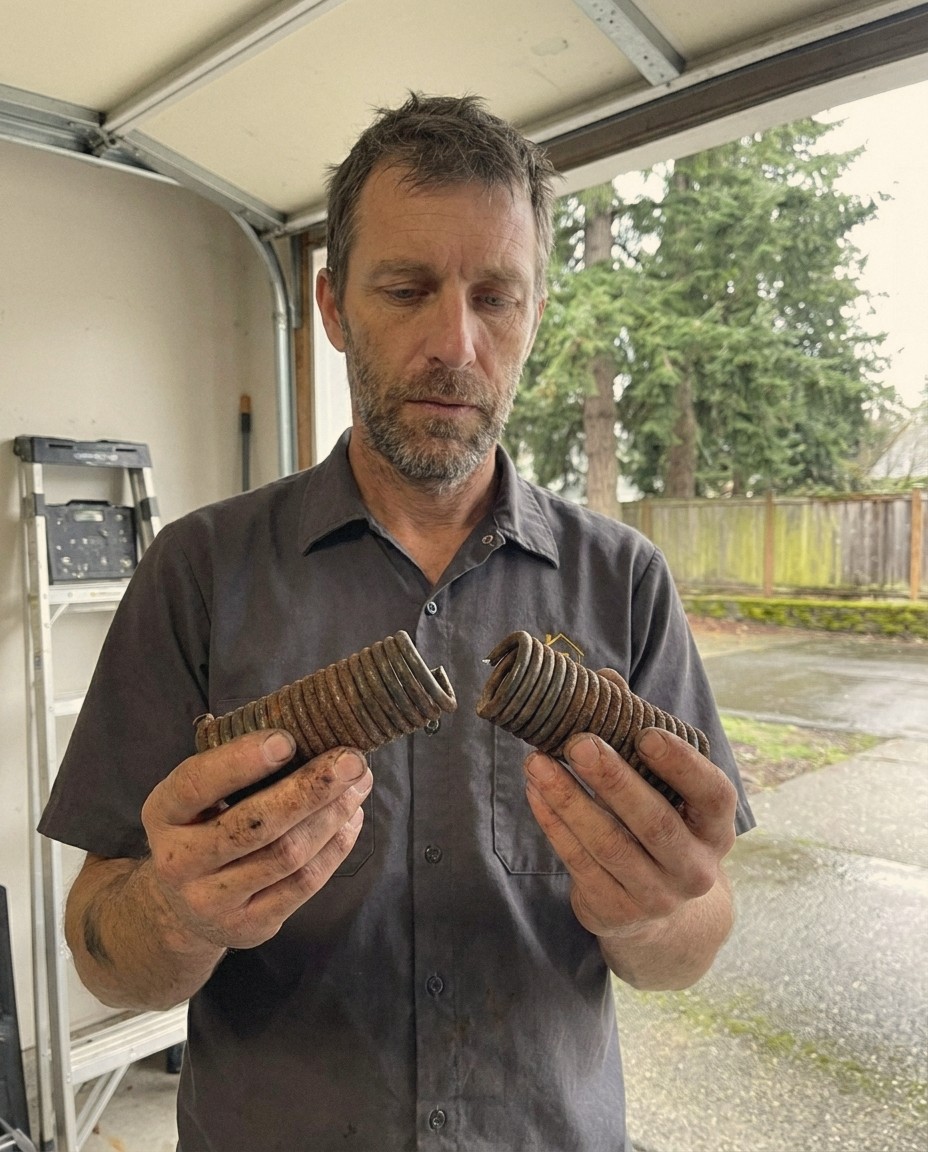
- A visible gap in the coil. A healthy torsion spring is one continuous coil. A broken one shows a two inch gap, usually with rust on the fresh break.
- The door is suddenly heavy. With the door fully closed, pull the red release cord, then lift by hand. A balanced door lifts easily and stays at waist height. Stop if it feels heavy, and never release the cord on an open or partly open door; a heavy door means a weak or broken spring.
- The door opens a few inches and stops. The opener lifts, hits its force limit against a door with no spring help, and quits. This is also hard on the opener gear.
- The door is crooked or the cables are loose. One side gets spring help and the other does not, or a cable has come off the drum because the spring no longer holds tension.
- Rust streaks and a stretched look. Orange streaking on the coils, or a torsion spring with uneven coil spacing, means the spring is fatiguing. Plan the replacement before it chooses the day for you.
If you see any of these on your door, stop using the opener and call or text Perfection Garage Door at (425) 264-8378.
Why spring replacement is not a DIY job
A wound torsion spring on a typical two-car door holds the force needed to lift a door of two hundred pounds or more, and it releases that force in an instant if a winding bar slips or the wrong tool is used. Sizing is the second problem: springs are matched by wire diameter, inside diameter and length to the door’s weight, and a spring that is close but wrong leaves the door unbalanced, which wears out the opener and the cables. The third is that springs should be replaced in pairs on a two-spring door; the second spring has the same cycles on it and the same rust, and it often follows the first within months. Perfection Garage Door’s garage door spring repair service covers torsion and extension systems across Renton, Kent, Tukwila, Newcastle and the Eastside.
What a spring replacement visit involves
- Inspection and written quote first. The technician checks springs, cables, drums, rollers, hinges and the opener, then hands you a written quote with options before any work starts.
- Measuring the old spring. Wire size, inside diameter and length are measured so the replacement matches the door’s weight, or is upgraded to a high-cycle rating if you choose.
- Securing the door. The door is clamped closed and the opener disconnected.
- Unwinding and removing. Any remaining tension is released with winding bars, and both springs, often with the cables, come off the shaft.
- Installing the new pair. New springs go on, the center bearing and end bearings are checked or replaced, and cables are seated on the drums.
- Winding and balancing. The springs are wound to the manufacturer’s turn count, then the door is tested by hand until it stays put at any height.
- Lubrication and safety test. Springs, bearings, hinges and rollers are lubricated, the opener is reconnected, its force and travel limits are checked, and the reversal test is run.
Most spring replacements finish in a single visit because the truck carries the common spring sizes for the doors installed around south King County. That includes the 1990s and 2000s subdivisions in Maple Valley, where whole streets of original springs are reaching their cycle limit at the same time.
When a spring failure means it is time for a new door
A broken spring on a solid door is a repair. A broken spring on a door that is twenty-plus years old, with rusted bottom panels or a cracked wood section, is a chance to stop fixing the old door one part at a time. An insulated steel door is quieter and warmer for the rooms above and beside the garage, and it comes with new springs, cables and rollers as part of the job. Perfection Garage Door’s new garage door installation page covers the door styles and insulation levels that work for Western Washington homes. For the pros and cons of steel, wood and composite in our rain, see the garage door material guide for the Puget Sound climate.
Garage door spring lifespan FAQs
How many years do garage door springs last in Western Washington?
Standard 10,000 cycle springs typically last four to seven years in a Western Washington home, depending on daily use and how damp the garage is. High-cycle springs rated for 25,000 cycles or more commonly last ten to fifteen years or longer on the same door.
Should both springs be replaced when one breaks?
Yes, on a two-spring door. Both springs were installed together, have the same cycle count and the same rust, and the surviving spring usually fails within months. Replacing the pair keeps the door balanced and avoids a second service visit.
Are high-cycle springs worth it?
For a door that moves four or more times a day, usually yes. A 25,000 cycle spring on a four cycle per day door is rated for about seventeen years in a dry garage against seven for a standard spring, and the lower stress per coil gives more margin before rust pitting matters. The technician can quote both options on the same visit.
Can I use my garage door with a broken spring?
No. Without the spring, the opener is lifting the full door weight, which strips gears and can snap the cables, and lifting a broken-spring door by hand is a real injury risk. Leave the door closed and call for service; a technician can open the door safely and replace the spring on the same visit.
Does lubricating the springs really extend their life?
Yes, in our climate it matters more than in a dry one. A light coat of silicone or lithium garage door spray twice a year slows surface rust, which is the main reason springs in Renton, Kent and Tukwila fail short of their cycle rating. Wipe off excess so it does not drip onto the door.
About Perfection Garage Door
Perfection Garage Door is a locally owned garage door repair and installation company based in Renton, WA 98057, serving Renton, Kent, Bellevue, Issaquah, Sammamish, Tukwila and Newcastle since 2010. The team repairs springs, cables, rollers, panels and openers, installs new insulated steel, carriage house, glass and wood doors, and offers same-day service across south King County. Every job starts with a written quote. Call or text Perfection Garage Door at (425) 264-8378, 24 hours a day.