
Updated October 2026.
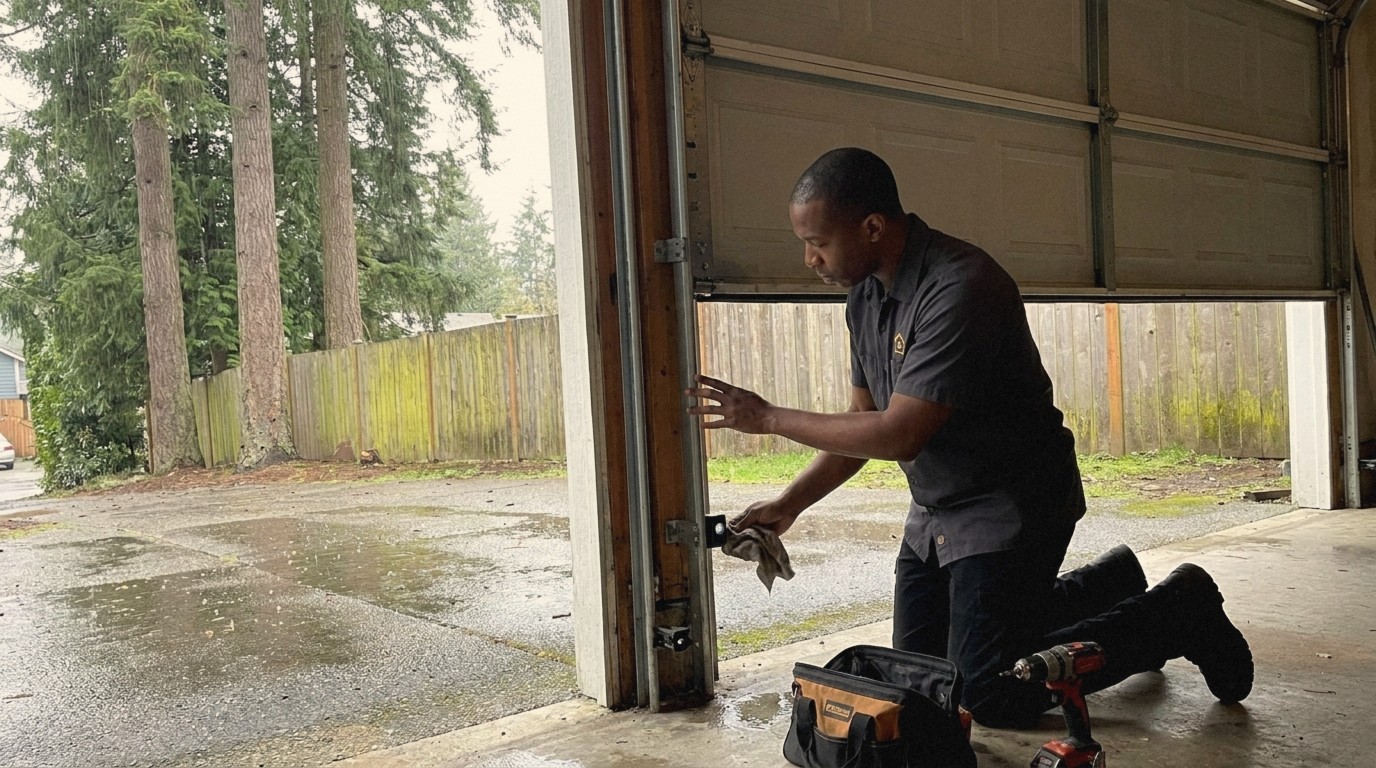
A garage door that won’t close all the way in Renton is almost always one of six problems: fogged or misaligned photo-eye sensors, a swollen bottom seal or wood door, a down travel limit set wrong, fir needles and grit packed into the tracks, a bent track or worn rollers, or an opener force setting that is too low. Five of the six get worse in our wet season, early October through the start of May. Perfection Garage Door walks through each cause, what is safe to fix yourself, and when to stop and call for garage door repair.
Quick diagnosis: match the symptom to the cause
| What the door does | Most likely cause in a Renton garage | Safe to try yourself? |
|---|---|---|
| Starts down, reverses right away, opener light blinks | Photo-eye sensors fogged, dirty or knocked out of line | Yes: clean and realign |
| Stops with a visible gap at the floor and does not reverse | Down travel limit set too short | Yes: adjust limit per the manual |
| Touches the floor, then reverses or pops back up | Swollen or new bottom seal, down travel limit set too long, or a settled slab | Yes: inspect seal, adjust limit in small steps |
| Shudders, hesitates or reverses partway down | Fir needles, moss or grit in the tracks, or rollers worn flat | Yes: clean tracks; rollers need a technician |
| Closes crooked or binds on one side | Bent track, broken cable, or one failed spring | No: stop using the door and call |
| Reverses at the same spot every time | Obstruction in track, bent section, or force setting too low for a heavy wet door | Partly: clear track; leave force settings alone |
| Will not move at all, opener hums | Broken spring, stripped gear or disengaged trolley | No: call for opener or spring service |
1. Photo-eye sensors fogged or misaligned in the wet months
Photo-eye safety sensors are the first thing to check when a garage door in Renton will not close all the way. Federal safety rules (CPSC 16 CFR Part 1211, which references UL 325) have required entrapment protection on residential openers made since January 1, 1993, most often photo-eyes mounted no higher than six inches off the floor on each side of the opening. When the beam between them is broken, the opener refuses to close, or reverses and flashes its light. In Renton that beam gets broken by water as often as by objects: cold nights from November through February leave condensation on the lenses, rain blown under the door leaves droplets, and winter cobwebs in a damp garage scatter the beam.
The fix is simple: with the door open, wipe both lenses with a dry microfiber cloth, clear anything within a foot of each sensor, and check the indicator lights. On most openers the sending eye shows steady amber and the receiving eye steady green; a green light that is off or flickering means the eyes are out of line. Loosen the wing nut, nudge the sensor until the green light holds, and tighten it. On a west-facing garage in Kennydale or the Highlands, low winter sun can also wash out the beam. Chamberlain’s support site has model-by-model sensor guides: support.chamberlaingroup.com.
2. Wood doors and weatherstrip swelling
A door that stops an inch above the concrete and backs up is often a moisture problem, not an opener problem. The rubber bottom seal on a steel door and the bottom rail on a wood door both absorb water through a Puget Sound winter, meet the floor sooner than the opener expects, and the opener reads that early contact as an obstruction. Older wood doors on pre-1980 homes near the Cedar River and on Renton Hill are the most prone to this, because the bottom rail, jambs and weatherstrip all swell at once.
Check the bottom seal for a spongy, waterlogged feel, cracks or sections pulled out of the retainer. A thicker replacement seal changes where the door meets the floor, which is why a new seal is often followed by the travel limit problem below. For a wood door, let it dry, then prime and paint the bottom rail and edges.
3. Travel limit settings
On a Renton garage door, the down travel limit tells the opener how far to move before the door counts as closed. Set short, the door stops with a gap at the floor; set long, the door hits the slab, senses resistance and reverses. Both show up after a new bottom seal, a new door, a stretched chain, or a slab that has settled or heaved, common on the fill soils of the Green River valley floor in Tukwila and south Renton.
Adjusting travel limits is a homeowner job on most openers, but only by the manual. Older chain and belt drives use two limit screws on the motor housing; newer units set limits with buttons on the motor head. Make small changes and run a full cycle after each. Do not keep extending the down limit to force a seal: if the door needs more travel than it did last year, something is physically in the way.
4. Debris in the tracks: fir needles, moss and grit
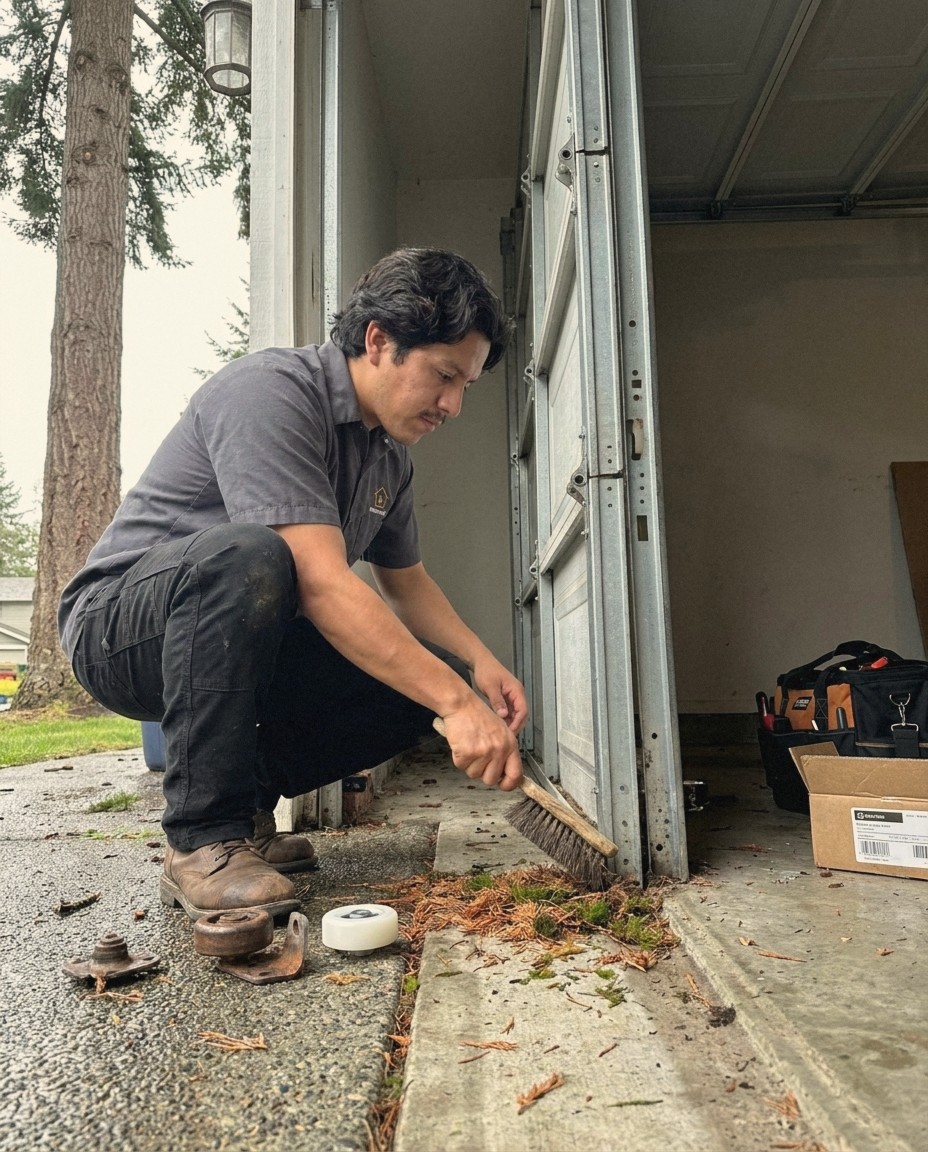
Tracks packed with Douglas fir needles, moss and grit are a Western Washington problem. Needles blow in under the door every fall, get wet and harden into a wedge in the lower track and the curve. A roller hitting that wedge jolts the door, and the opener reads the jolt as an obstruction. Homes under mature trees in Fairwood, Maplewood Heights and along the Maple Valley Highway see the most of it.
Clear the tracks with the door open and the opener unplugged, using a stiff brush and a shop vacuum. Do not grease the tracks. Lubricate the rollers, hinges and springs with a silicone or lithium garage door spray instead, in October before the rain and again in spring.
5. Bent track or worn rollers
In Renton, original steel rollers on 1990s and early 2000s doors in Benson Hill, Talbot Hill and the Highlands have often worn flat or lost bearings by now, and a flat roller drags in the curve, so the door hesitates, chatters and may reverse. A track bent by a bumper or a dropped ladder does the same, and can let a roller jump out, which is when a door jams crooked.
Look along each track for dents or a section pulled from the wall, and spin each roller by hand; wobble or grinding means replacement. Sealed nylon rollers run quieter and tolerate moisture better than open steel bearings. Roller and track work involves the bottom bracket, which is under spring tension, so it belongs to a technician.
6. Opener force settings
The force setting on a Renton garage door opener controls how much resistance it pushes against before it reverses. A door that has gotten heavier because the panels are waterlogged, the rollers drag or a spring has weakened can trip the force limit on the way down. Turning the force up masks the symptom and defeats the safety reversal. If the opener needs more force than it did last winter, the door has a mechanical problem: fix the cause, then lay a 2×4 flat under the door and close it; the door must reverse on contact. If it does not, stop using the opener and call for garage door opener repair.
The safe check order, step by step
Perfection Garage Door’s safe homeowner check order for a garage door that won’t close in Renton:
- Look before touching. With the door closed, check both springs for a gap in the coil and both cables for fraying. If either looks wrong, stop and call.
- Clean and realign the photo eyes. Wipe lenses, clear the area, confirm steady lights.
- Clear the tracks. Opener unplugged, brush and vacuum both tracks.
- Inspect the bottom seal. Replace a swollen, torn or missing seal.
- Test the balance. With the door fully closed, pull the red release cord, lift the door to waist height and let go. A balanced door stays put; one that drops, rises or feels very heavy has a spring problem, so stop and call. Never pull the cord on an open door. Close the door, then run the opener until the trolley clicks back in before the next step.
- Adjust the travel limit. Small steps, per the manual, only on a balanced door with clean tracks.
- Run the reversal test. The 2×4 test above. Fail means opener service.
When to stop and call Perfection Garage Door
Stop troubleshooting a garage door that won’t close in Renton the moment you see a gap in a spring coil, a loose or frayed cable, a door hanging crooked, a door that is suddenly very heavy to lift, or a roller outside the track. Each means the door is held by one spring, one cable or nothing, and the next cycle can drop it. A door that passes every check and still reverses usually has an opener fault: a worn travel module, a failing logic board or a stripped gear. Perfection Garage Door handles both across Renton, Kent, Tukwila, Newcastle and south King County, with a written quote before any work begins. The same crews cover garage door repair in Maple Valley, where fir needles packed into the tracks are the most common reason a door reverses. For LiftMaster error codes and blinking light patterns, see our LiftMaster opener troubleshooting guide.
Garage door won’t close: Renton FAQs
Why does my garage door only refuse to close when it rains?
Rain and cold put condensation and water droplets on the photo-eye lenses, swell the bottom seal, and wash fir needles into the tracks. All three make the opener think something is in the way. In Renton the wet season runs from October into early May, so a door that misbehaves only in those months almost always has a sensor or moisture issue rather than a motor fault.
Can I bypass the safety sensors to get the door closed?
Holding the wall button down will usually close the door past a sensor fault, because the opener treats a held button as a deliberate command. Use that only to secure the garage once, then fix the sensors. Disconnecting or taping over the eyes removes the entrapment protection federal rules have required on residential openers since 1993 and should never be a permanent solution.
The door closes, then pops back up a few inches. What is that?
The door is hitting the floor before the opener expects it to, usually because of a new or swollen bottom seal, a slab that has shifted, or a down limit set too long. Check the seal first, then adjust the down travel limit in small steps per the opener manual.
Why does the door close crooked?
A crooked door means one side is moving and the other is not: a broken cable, a bent track, a roller out of the track or a single failed spring. Do not run the opener again. The door can jam or fall, and a technician needs to rebalance it.
How often should a Renton garage door be lubricated and checked?
Twice a year works for our climate: once in October before the rain starts and once in spring. Clean the tracks, spray rollers, hinges and springs with a garage door lubricant, wipe the sensors and run the balance and reversal tests. Doors under heavy tree cover benefit from a track cleaning midwinter as well.
About Perfection Garage Door
Perfection Garage Door is a locally owned garage door repair and installation company based in Renton, WA 98057, serving Renton, Kent, Bellevue, Issaquah, Sammamish, Tukwila and Newcastle since 2010. The team repairs springs, cables, rollers, panels and openers, installs new insulated steel, carriage house, glass and wood doors, and offers same-day service across south King County. Every job starts with a written quote. Call or text Perfection Garage Door at (425) 264-8378, 24 hours a day.